Both flagships now start at $1,299, so the choice comes down to a 35g weight gap, a battery lead and one very different idea of what a big phone should do.
· 5 min read
If you want the longest battery life, the fastest chip and the better low-light camera, buy the iPhone 18 Pro Max. If you want a phone that is 35 grams lighter, hides its screen from the person next to you and carries a stylus and a longer telephoto lens, buy the Galaxy S26 Ultra. The old price argument is gone, because both start at $1,299 in the US.
Specifications side by side
| Feature | iPhone 18 Pro Max | Galaxy S26 Ultra |
|---|---|---|
| Display | 6.9-inch OLED, 2868 x 1320, 1 to 120Hz | 6.9-inch Dynamic AMOLED 2X, QHD+, 1 to 120Hz |
| Peak brightness (official) | 3,000 nits outdoor | 2,600 nits |
| Size and weight | 163.4 x 78.0 x 8.75mm, 249g | 163.6 x 78.1 x 7.9mm, 214g |
| Chip | A20 Pro | Snapdragon 8 Elite Gen 5 for Galaxy (3nm) |
| Storage | 256GB, 512GB, 1TB, 2TB | 256GB, 512GB, 1TB |
| Main camera | 48MP, variable f/1.48 to f/4.0 | 200MP, f/1.4 |
| Ultra wide | 48MP, f/2.2 | 50MP, f/1.9 |
| Telephoto | 48MP, 4x optical, f/2.8 | 10MP 3x and 50MP 5x optical |
| Front camera | 18MP Center Stage | 12MP |
| Battery rating | Up to 45 hours video playback (Apple) | 5,000mAh, up to 31 hours video playback (Samsung) |
| Wired charging | About 50% in 15 minutes with a compatible adapter | Up to 60W, about 75% in 30 minutes |
| Wireless charging | 25W MagSafe and Qi2, magnets built in | 25W |
| Software at launch | iOS 27 | One UI 8.5 on Android 16 |
| Price (US, 256GB) | $1,299 | $1,299.99 |
Apple and Samsung publish the figures above. Apple does not publish a battery capacity, so any milliamp-hour number for the iPhone comes from third parties.
Design and display
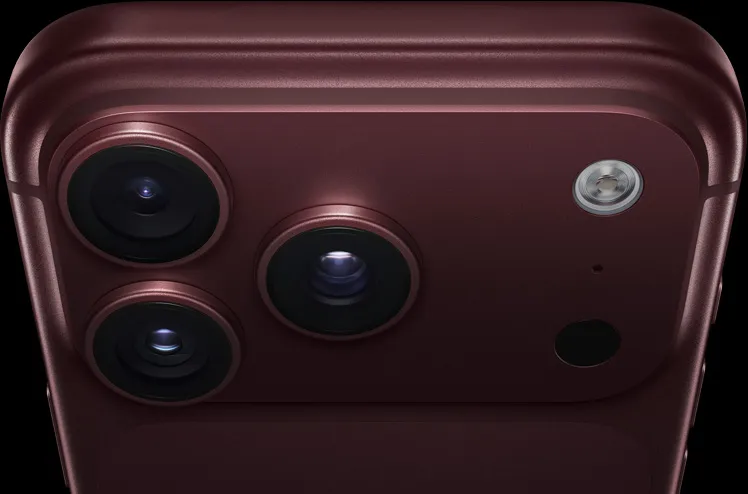
The footprints are almost identical, but the phones feel nothing alike. The iPhone is a gently curved aluminium slab that weighs 249g, the heaviest iPhone yet, and it is nearly a millimetre thicker than the 214g Samsung. Tom's Guide called the iPhone the more refined piece of hardware, and Android Central found its curves more comfortable to hold. Samsung's flatter frame is the lighter of the two and still has room for the built-in S Pen.
The screens split on philosophy. Apple quotes 3,000 nits outdoors and Tom's Guide measured roughly 2,300 nits against about 1,800 for the Samsung, so the iPhone is easier to read in harsh sun. Samsung's answer is the built-in Privacy Display, which narrows the viewing angle for specific apps, notifications or PIN entry. Android Central says it costs some resolution, brightness and anti-reflective performance compared with last year's Ultra, so it is a trade rather than a free feature.
On the numbers a lab can measure, Apple wins. On the features a lab cannot, Samsung still has a case.
Performance
This is the widest gap. In Tom's Guide testing, the A20 Pro scored 4,741 single-core and 12,789 multi-core in Geekbench 6, against 3,785 and 11,563 for the Samsung. In 3DMark Solar Bay Unlimited the iPhone averaged 67.9fps against 49.37fps. The Samsung wins one test, a Geekbench AI run that uses different frameworks on each phone, so treat that result with caution. Apple says its bigger vapor chamber delivers up to 40 percent better sustained performance than the iPhone 17 Pro, and Samsung claims a 21 percent thermal gain over the S25 Ultra. In a stress test, Tom's Guide recorded 79.4 percent stability for the Pro Max and 53.9 percent for the Galaxy.
Cameras
The Samsung has more glass and more reach, with a 3x and a 5x telephoto, and in Tom's Guide tests its 40x shots resolved small text better. It also keeps Horizon Lock for level video. The iPhone's advantage is the mechanical aperture on its 48MP main camera, which opens to f/1.48 for low light and stops down to f/4.0 for depth. Tom's Guide found sharper low-light shots, better portraits and a more balanced ultra wide on the iPhone, and called the video results close. Apple also now offers manual Pro controls, which removes one of Samsung's old advantages.
Battery and charging
Apple rates the Pro Max for up to 45 hours of video playback on eSIM models, against Samsung's 31 hours for a 5,000mAh cell that has not grown since the first S Ultra. In Tom's Guide's web-browsing drain test the iPhone lasted 18 hours 27 minutes and the Galaxy 16 hours 40 minutes. Android Central measured 50 percent in 15 minutes for the iPhone and 41 percent for the Galaxy, while Tom's Guide found 80 percent against 77 percent after 30 minutes. Samsung sells a Magnet Case to match the iPhone's built-in magnetic charging. Independent tester Dave2D saw smaller gains in heavy gaming, so the advantage is biggest in ordinary use.
Software and updates
Samsung promises seven generations of OS upgrades and seven years of security updates from launch, a written commitment Apple's spec page does not state. The S26 Ultra shipped with Android 16, and One UI 9 on Android 17 began reaching phones in September with a staggered rollout, so check your carrier. Tom's Guide preferred Samsung's Gemini-based assistant and DeX desktop mode, and praised the iPhone's new Siri AI for on-screen context. Android Central notes that iOS is the more closed of the two.
Price and availability
The S26 Ultra went on sale on 11 March and the iPhone 18 Pro Max on 18 September. Both start at $1,299 for 256GB, Apple after a $100 rise and Samsung at $1,299.99. Samsung's US site was advertising a Black Friday offer of $350 off without a trade-in at the time of writing, which tilts the value argument its way. Apple's 2TB option has no Samsung equivalent.
Which should you buy?
Buy the iPhone 18 Pro Max if battery life, speed, and low-light photos and video matter most, and you can live with 249g and an eSIM-only phone in the US. Buy the Galaxy S26 Ultra if you want the lighter body, Privacy Display, S Pen, the 5x telephoto and a written seven-year update promise, particularly if a discount brings the price below Apple's. For most buyers choosing purely on specifications, Apple has the stronger phone this year. For commuters who read messages in public and heavy note-takers, Samsung still offers something Apple does not.
Related reading: our iPhone 18 Pro vs Galaxy S26 Ultra comparison, our iPhone 18 Pro review and the Pixel 11 Pro XL vs Galaxy S26 Ultra comparison. Specifications come from Apple's technical specifications and Samsung's launch announcement; test results come from Tom's Guide, Android Central and Notebookcheck.
Published 19 November 2026. Gadgets365 will update this article as more information becomes available.
Editor
Pravin KankanePravin Kankane is the editor of Gadgets365, an independent technology publication based in Pune, India. He covers smartphones, AI, Apple, Android and consumer tech launches in India.