OpenAI Brings GPT-6 to ChatGPT With Intelligent UI, Turning Answers Into Interactive Pages
GPT-6 Sol reached paying ChatGPT users on October 7, and GPT-6 Luna follows for Free and Go users. The new interface mixes text with charts, forms and tools, and OpenAI says answers start 44 percent sooner.
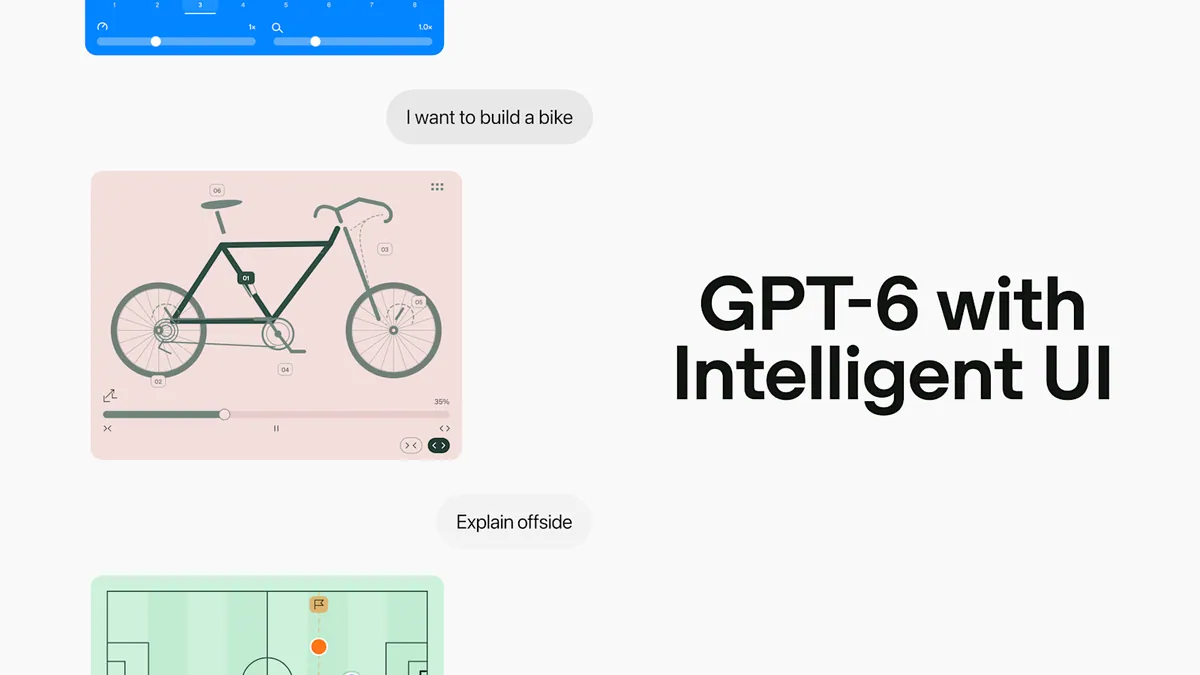
OpenAI has started rolling out GPT-6 to everyday ChatGPT conversations alongside a new interface called Intelligent UI, which lets answers arrive as interactive pages with buttons, forms and charts instead of plain text. The rollout began on October 7 for paying users and reaches Free and Go users from October 8 (NYU Shanghai RITS, Let's Data Science).
What OpenAI announced
OpenAI says GPT-6 with Intelligent UI is rolling out globally to ChatGPT in the Chat tab, with different models by plan:
| ChatGPT plan | Model | Start of rollout |
|---|---|---|
| Plus, Pro, Business, Enterprise | GPT-6 Sol | October 7 |
| Free, Go | GPT-6 Luna | October 8 |
OpenAI describes both models as tuned for everyday conversation. Sol and Luna first launched on September 22 in ChatGPT Work, Codex and the API, at lower API prices than their predecessors (TechCrunch), so this release brings the family to the chat window most people use. Enterprise access depends on workplace admin settings, and OpenAI says the Work and Codex experiences are not changing with this release.
How Intelligent UI works
The idea is that ChatGPT picks the shape of the answer to suit the question. OpenAI says responses can mix text with graphics, tappable buttons, forms, charts and interactive experiences. A comparison may appear side by side, an explanation may become an interactive diagram, and a simple question can still get a plain paragraph.
OpenAI's examples include a visual meal plan, a road-trip plan, and interactive explanations of the Central Limit Theorem and the Monty Hall problem. ChatGPT can also generate small tools inside a conversation, such as a bill splitter, a retirement savings calculator and a retro game. Android Authority, which saw the demos, describes a seven-speed bicycle breakdown with buttons for the frame, wheels, drivetrain, brakes and cockpit, and a Sunday roast planner with guest-count controls that rescale shopping quantities.
Under the hood, OpenAI says a library of native, streamable components and a compiler render the interface progressively while the model is still generating it, which is why a page can start appearing before the full answer exists. Android Authority reports that users can ask for simpler text answers or fewer visuals.
Faster starts, with caveats
GPT-6 can begin answering while it is still reasoning, adding information in stages. OpenAI's headline figure is that, for questions that need web search, GPT-6 Instant starts answering 44 percent sooner on average than GPT-5.6 Instant. That measures time to first response, not total completion time, and OpenAI does not describe the test setup.
OpenAI also says, from internal evaluations, that GPT-6 Extra High begins answering in about the same time as GPT-5.6 Medium while scoring better overall than GPT-5.6 Extra High on everyday agentic tasks, and that on difficult web-search problems GPT-6 addressed the key part of a question more often than GPT-5.6. Independent benchmarks have not yet appeared.
Safety claims
OpenAI says GPT-6 resists attempts to bypass its safety training better than earlier models, especially multi-turn attacks, and handles high-risk misuse involving cyberattacks, biological threats and violence more carefully. It also says the model should refuse harmless requests less often and be clearer about its limits. The system card is published on OpenAI's deployment safety site. These are the developer's descriptions rather than outside findings.
What it means for users
For paying users, the chat window may start returning interface elements where it used to return paragraphs. For Free and Go users, GPT-6 Luna and the new interface arrive together (YourStory).
The harder question is whether people want their chatbot to behave like an app builder. A bill splitter generated on demand is convenient, but answers are now harder to copy, quote and verify than a block of text. OpenAI has not said how interactive outputs are handled in exports, shared chats or screen readers, or whether the new interface has its own usage limits. Rollouts are gradual, so not every account will see the update on day one.
What to watch next
Watch for independent tests of the 44 percent claim and of GPT-6 Luna on the free tier, how the interactive components behave on slow connections and in the mobile apps, whether Intelligent UI reaches Work and Codex, and reports of wrong calculations inside polished widgets.
'/%3E%3Cstop offset='1' stop-color='rgb(34,52,84)'/%3E%3C/linearGradient%3E%3C/defs%3E%3Crect width='1200' height='675' fill='url(%23g)'/%3E%3Cg fill='rgb(110,200,255)'%3E%3Crect x='120' y='440' width='56' height='110' rx='6'/%3E%3Crect x='196' y='405' width='56' height='145' rx='6'/%3E%3Crect x='272' y='360' width='56' height='190' rx='6'/%3E%3Crect x='348' y='315' width='56' height='235' rx='6'/%3E%3Crect x='424' y='255' width='56' height='295' rx='6'/%3E%3Crect x='500' y='195' width='56' height='355' rx='6'/%3E%3C/g%3E%3Cg fill='rgb(140,150,175)'%3E%3Crect x='680' y='470' width='56' height='80' rx='6'/%3E%3Crect x='756' y='466' width='56' height='84' rx='6'/%3E%3Crect x='832' y='472' width='56' height='78' rx='6'/%3E%3Crect x='908' y='468' width='56' height='82' rx='6'/%3E%3Crect x='984' y='465' width='56' height='85' rx='6'/%3E%3Crect x='1060' y='470' width='56' height='80' rx='6'/%3E%3C/g%3E%3Crect x='100' y='556' width='1036' height='6' rx='3' fill='rgb(220,230,245)'/%3E%3Ccircle cx='620' cy='200' r='16' fill='rgb(255,200,90)'/%3E%3C/svg%3E)
'/%3E%3Cstop offset='1' stop-color='rgb(70,40,90)'/%3E%3C/linearGradient%3E%3C/defs%3E%3Crect width='1200' height='675' fill='url(%23g)'/%3E%3Cg stroke='rgb(240,200,120)' stroke-width='10' stroke-linecap='round' fill='none'%3E%3Cpath d='M600 150V540M480 540H720M360 220H840'/%3E%3Cpath d='M360 220L290 360H430ZM840 220L770 360H910Z'/%3E%3C/g%3E%3Ccircle cx='600' cy='140' r='18' fill='rgb(240,200,120)'/%3E%3Cpath d='M290 360A70 40 0 0 0 430 360ZM770 360A70 40 0 0 0 910 360Z' fill='rgb(240,200,120)'/%3E%3C/svg%3E)
'/%3E%3Cstop offset='1' stop-color='rgb(22,84,90)'/%3E%3C/linearGradient%3E%3C/defs%3E%3Crect width='1200' height='675' fill='url(%23a)'/%3E%3Cg fill='rgb(120,230,210)'%3E%3Crect x='230' y='420' width='110' height='140' rx='10' opacity='.45'/%3E%3Crect x='390' y='350' width='110' height='210' rx='10' opacity='.6'/%3E%3Crect x='550' y='270' width='110' height='290' rx='10' opacity='.75'/%3E%3Crect x='710' y='170' width='110' height='390' rx='10'/%3E%3C/g%3E%3Cg fill='none' stroke='rgb(255,215,120)' stroke-width='6' stroke-linecap='round'%3E%3Cpath d='M240 400L400 330 560 250 765 140'/%3E%3C/g%3E%3Cg fill='rgb(255,215,120)'%3E%3Ccircle cx='240' cy='400' r='14'/%3E%3Ccircle cx='400' cy='330' r='14'/%3E%3Ccircle cx='560' cy='250' r='14'/%3E%3Ccircle cx='765' cy='140' r='14'/%3E%3C/g%3E%3Cg fill='none' stroke='rgb(120,230,210)' stroke-opacity='.5' stroke-width='4'%3E%3Ccircle cx='980' cy='230' r='70'/%3E%3Ccircle cx='980' cy='230' r='120'/%3E%3C/g%3E%3Crect x='180' y='575' width='700' height='6' rx='3' fill='rgb(120,230,210)' opacity='.6'/%3E%3C/svg%3E)