Tamron Brings Its Compact 20-40mm f/2.8 Zoom to Nikon Z for $729, Arriving October 22
The 380g full-frame zoom first appeared for Sony E in 2022. The Nikon version costs $30 more and has no built-in stabilisation.
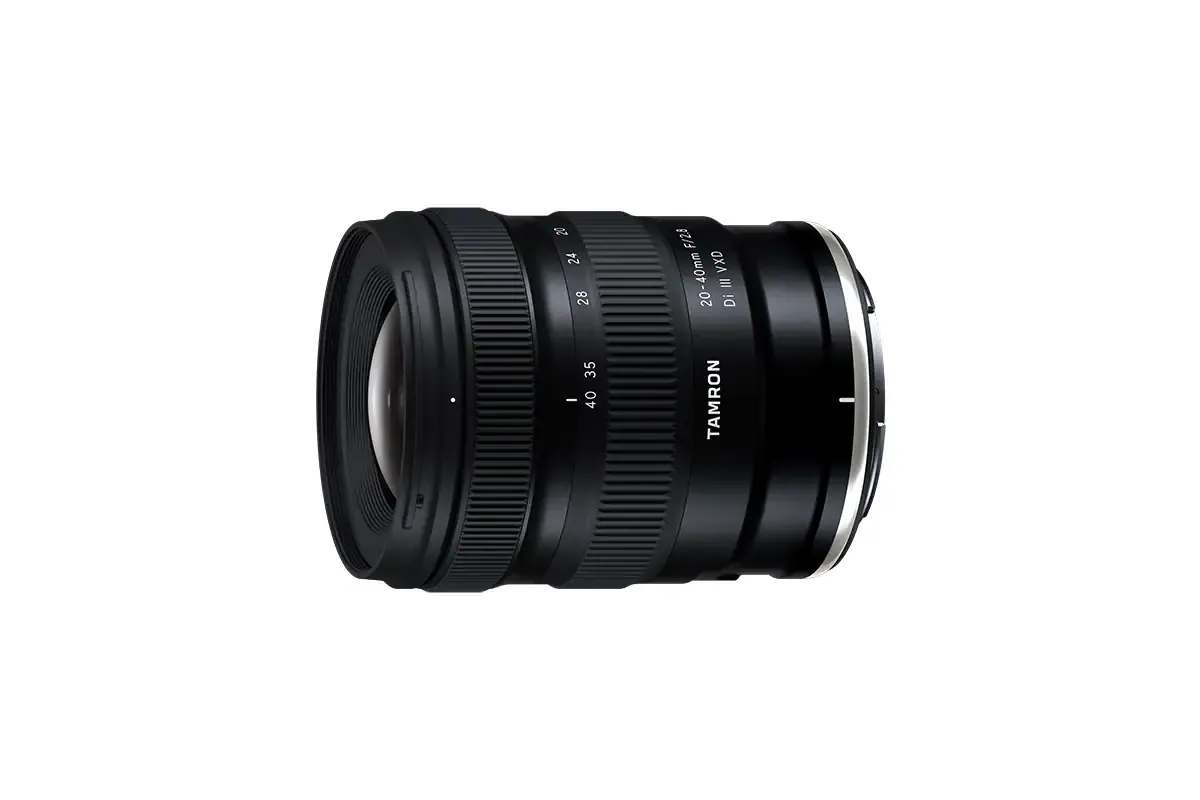
Tamron has announced a Nikon Z version of its 20-40mm f/2.8 Di III VXD, a compact full-frame standard zoom that has been available for Sony E mount since 2022. The lens costs $729 in the United States and $999 in Canada, and goes on sale on October 22 (Tamron, Fstoppers).
What Tamron announced
Tamron lists the lens as Model A062 for Nikon Z mount. It has 12 elements in 11 groups, a maximum aperture of f/2.8 at both ends of the zoom range and a minimum of f/22. Nine blades form a circular diaphragm that Tamron says stays close to round up to two stops down from wide open. In Japan, Tamron lists it at 119,900 yen including tax. Nikon Rumors counts it as Tamron's 13th lens for Nikon Z.
Tamron calls the lens class-leading in size and weight among fast standard zooms for full-frame mirrorless cameras. That comparison is the company's own, based on a survey it dates to August 2026.
DPReview, which first reported the price, says the optics are unchanged from the Sony version. Fstoppers reports that the Nikon model is developed, manufactured and sold under a licence agreement with Nikon, so Tamron is selling it with Nikon's approval rather than as an unlicensed alternative.
Key specifications
| Specification | Tamron 20-40mm f/2.8 Di III VXD (A062, Nikon Z) |
|---|---|
| Optical design | 12 elements in 11 groups |
| Aperture | f/2.8 to f/22, 9 rounded blades |
| Minimum focus | 0.17m at 20mm (1:3.8), 0.29m at 40mm (1:5.1) |
| Length and diameter | 88.7mm x 74.4mm (Sony E figure, per Tamron's footnote) |
| Weight | 380g (Sony E figure, per Tamron's footnote) |
| Filter thread | 67mm |
| Autofocus | VXD linear motor |
| Stabilisation | None in the lens |
| Price | $729 (US), $999 (Canada), 119,900 yen (Japan) |
| On sale | October 22, 2026 |
Size, weight and handling
A footnote on Tamron's specification sheet says the length and weight figures are for the Sony E-mount version, so the Nikon numbers may differ slightly. Camera Jabber gives the same 380g weight and an 89mm length. CameraEgg lists the Sony lens at 365g and 86.5mm long, which would make the Nikon version about 15g heavier and 2.2mm longer, but that comparison comes from one outlet and Tamron has not spelled it out.
The zoom ring turns through 65 degrees, which is short and suits quick framing changes. Close focusing is useful for a lens this size: 0.17m at 20mm gives 1:3.8 magnification, and 0.29m at 40mm gives 1:5.1.
Autofocus uses Tamron's VXD linear motor for both stills and video. The lens has moisture-resistant construction and a fluorine coating on the front element, and it supports Tamron Lens Utility, Tamron-Link and camera key functions. It ships with a flower-shaped hood and front and rear caps. Fstoppers notes that the specification sheet lists no optical stabilisation, so photographers will rely on the stabilisation in their Nikon body.
Price compared with Sony
At $729 the Nikon lens costs $30 more than the $699 Sony E version announced in 2022. DPReview argues that this is still cheaper than buying the Sony lens and an adapter, a fair point for Nikon owners who might otherwise have gone that route, though it ignores any autofocus compromises an adapter could bring. Pre-orders are open at US retailers.
DPReview names Sigma's 20-60mm f/2.8-4 as the closest alternative in size and weight, and notes that Sigma does not make it for Z mount. That leaves the Tamron without a direct rival of its kind for Nikon Z shooters who want a small, fast wide-to-short-tele zoom.
What the range gives you
A 20-40mm range is narrower than the 24-70mm standard zoom most photographers buy first. Its strength is the wide end, where 20mm covers landscapes, interiors and environmental portraits, along with an f/2.8 aperture that holds steady across the range. Tamron positions 40mm for everyday snapshots and portraits (PetaPixel), and says the lens equals roughly 30-60mm on an APS-C body, which makes it a reasonable walk-around option for crop-sensor Nikon cameras too. Those who need more reach will find 40mm limiting for portraits and event work.
What to watch next
Watch for the first independent tests, especially of sharpness at the edges and at 20mm; since the optics are unchanged, results should track the Sony lens. Also watch whether Tamron brings more of its Sony range to Z mount under the same licence.