Microsoft's Experimental Reactor Builds WinUI Apps in Pure C#, No XAML Needed
The open-source framework draws real WinUI controls from a single C# function. Microsoft says XAML is not being deprecated and the project has no support policy.
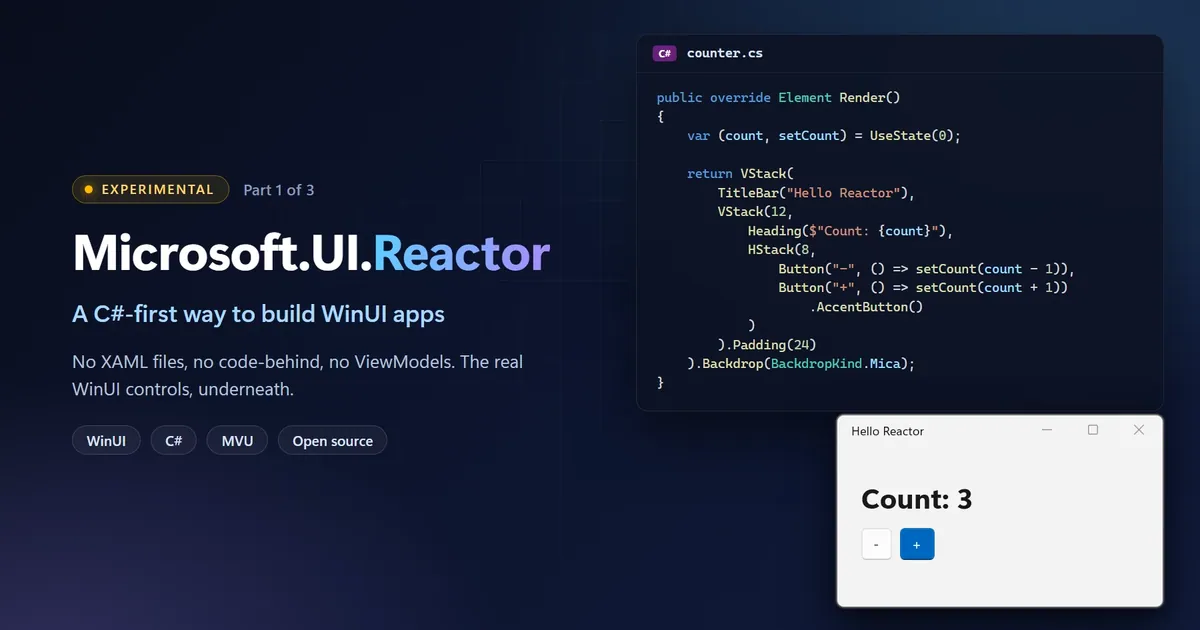
Microsoft has introduced Microsoft.UI.Reactor, an experimental open-source framework that lets developers build Windows apps with WinUI controls using only C#. The Windows developer blog post, published on October 21, describes a way to write an interface without XAML files, code-behind or view models. Windows Latest covered it on October 23 as part of Microsoft's push toward native apps.
What Reactor does
Reactor follows the Model-View-Update pattern. The developer describes the whole interface inside a C# Render function that returns a description of what the UI should look like, and the framework diffs it against the previous one and patches only the WinUI controls that changed. It does not draw its own controls: writing a Button or a NavigationView gives you the real WinUI control. In Microsoft's words, "XAML is a first-class way to use it, it isn't being deprecated."
The company's own counter example runs to about 12 lines in a single C# file. Windows Latest says a comparable XAML sample needs five files plus a project file. That is the outlet's comparison, and the saving will vary with the app.
Status, licence and requirements
| Microsoft.UI.Reactor | Details |
|---|---|
| Status | Experimental: no support policy, no API guarantees |
| Licence | MIT, on GitHub at microsoft/microsoft-ui-reactor |
| Package | Microsoft.UI.Reactor 0.1.0-preview.16 |
| Requirements | .NET 10 SDK, winapp CLI 0.7 or later (winget install Microsoft.WinAppCli) |
| Templates | reactor, reactor-mvu, reactor-navview, reactor-tabview |
| Tooling | 60+ Roslyn analyzers, about 20 samples |
Microsoft expects the experimental label to stay for the next few months and says the syntax may still change while it does. The company says it published this early because it would rather hear the design is wrong now than after people have shipped on it. The quick start runs a single file with <code>winapp run counter.cs</code>, or creates a project from one of the templates.
The bundled analyzers flag problems while code is being written, covering hooks, accessibility, theming and performance, so they matter most for teams that want consistent behaviour without manual review.
Why Microsoft is doing this
Windows Latest links the release to a wider complaint that many Windows 11 apps are web pages in a wrapper, pointing to the inbox Weather app, which uses WebView2 to load MSN content. Microsoft's own post does not make that argument, so the framing belongs to the outlet. The practical point is that Reactor lowers the effort of writing a native interface, which is one of the usual reasons developers reach for web technology. It is also aimed at developers bringing mobile or macOS apps to Windows, who are used to declaring UI in code.
What it is not
Reactor is not a new UI platform, and it does not replace WinUI, XAML or MVVM. It renders the same controls and works alongside XAML. It is not ready for production, given the missing support promise and the preview version number, and teams with existing XAML apps have no reason to migrate based on this announcement.
Who should care
The audience is mainly Windows developers, including India's large community of .NET developers and IT services teams who build internal Windows tools, and anyone comparing native options against web wrappers. Ordinary Windows users will not see any change from this announcement alone.
What to watch next
Whether Microsoft moves Reactor out of experimental status, publishes a support policy, or adopts it in first-party Windows apps. Feedback on the GitHub repository will show which gaps developers hit first.