Meta's Muse Spark Open Is an 816B Open-Weight Model Built to Run on Two Mac Studios
Meta says it is the most capable US open-weight model to date. It needs roughly 1TB of memory, the benchmark claims are Meta's own, and the license limits commercial use.
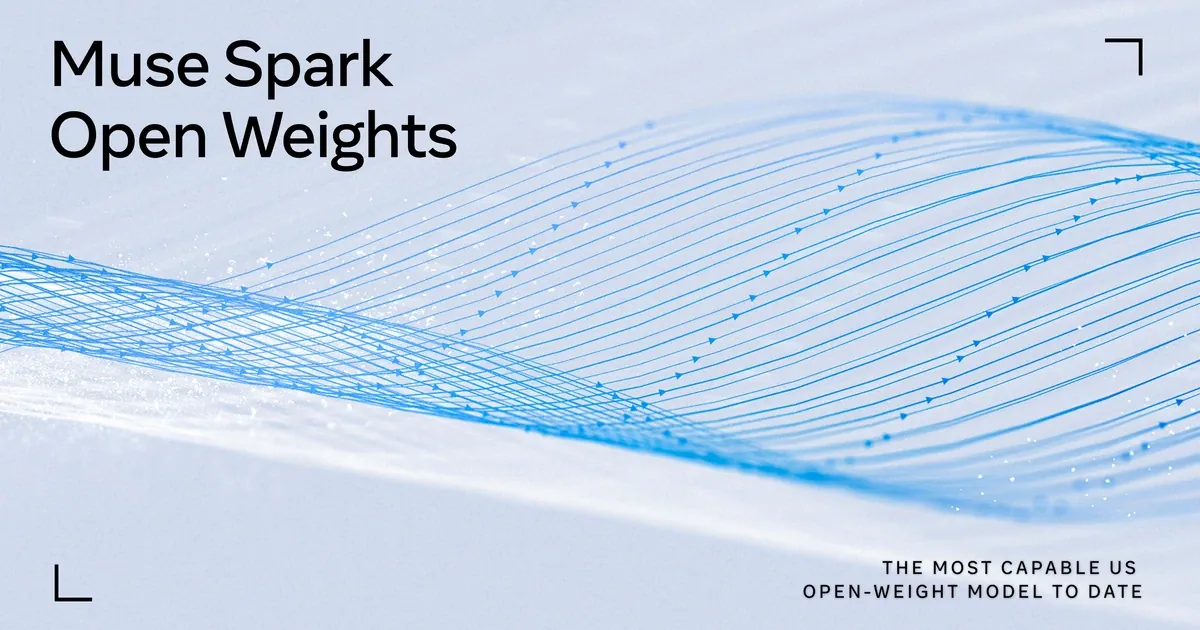
Meta has released the weights of a large language model designed to run on a desk. Muse Spark Open, published on October 15, has 816 billion parameters, and Meta says two Apple M5 Ultra Mac Studios are enough to run it locally (MarkTechPost, Hugging Face model card).
What Meta released
| Muse Spark Open | Details |
|---|---|
| Model name | Muse-Spark-Open-816B-A42B |
| Architecture | Natively multimodal mixture-of-experts |
| Parameters | 816 billion total, 42 billion active |
| Context window | 1 million tokens |
| Built for | Coding, agents, multi-step reasoning |
| License | Muse Model License (limited commercial terms) |
Meta calls it "the most capable US open-weight model to date." That is the company's own description, and the benchmark charts behind it are Meta's own, with a separate methodology report; independent results are not yet available.
Running it on a Mac
Meta says Muse Spark Open is the first model of its class to run on a desktop, using two M5 Ultra Mac Studios and Apple's MLX framework. Each machine supports up to 512GB of unified memory, so two together hold about 1TB, enough for the full model. The machines are linked over Thunderbolt 5 with RDMA, and MLX splits every layer across both (PPC Land, Quartz).
There is a catch: Apple has not yet released the 512GB Mac Studio, which is expected later this month, and the 256GB model already costs more than $10,000. Most people will use the model through a cloud host. Community quantised versions lower the bar somewhat: Unsloth's 2-bit GGUF builds reportedly fit in about 300GB of combined memory.
Where to get it
The weights are on Hugging Face, Amazon SageMaker, Google Cloud Model Garden and Microsoft Foundry Models. Hosted API access is available through Baseten, Fireworks AI, Groq, Modal, Nebius, OpenRouter and Together AI. Inference support covers SGLang, vLLM, TensorRT-LLM, Hugging Face Transformers, llama.cpp and Unsloth, and Meta says it is optimised for AMD, Apple, Intel and Nvidia silicon. Fine-tuning works through PyTorch TorchTitan.
Meta also describes SGLang GPU kernel work that it says gives 1.03 to 3.95 times kernel-level speedups on Nvidia and AMD hardware and a 3 percent end-to-end gain on AMD's MI350; these are Meta's figures.
The license is not fully open
The Muse Model License has limited commercial terms that Meta says let many developers use the model for free, but its blog does not set out the thresholds. "Open weights" does not mean unrestricted use, so developers, including Indian startups weighing it against fully open models, should read the license before building products on it. Meta says it added safety post-training, that the model met the thresholds of its Meta Superintelligence Scaling Framework, and that a full evaluation report is coming.
A notable Apple and Meta moment
Apple chief executive John Ternus wrote on X that it was "amazing to run a model of Muse Spark Open's caliber and scale this efficiently" from a desk, according to MacRumors, and Meta AI chief Alexandr Wang joked to Axios that "mommy and daddy" were playing nice again. The release follows Meta's closed Muse Wonder frontier models of October 12, showing Meta keeping an open line alive while its most capable systems stay proprietary.
What to watch next
Independent benchmark runs, the full license text and safety report, and the 512GB Mac Studio's release.
'/%3E%3Cstop offset='1' stop-color='rgb(34,52,84)'/%3E%3C/linearGradient%3E%3C/defs%3E%3Crect width='1200' height='675' fill='url(%23g)'/%3E%3Cg fill='rgb(110,200,255)'%3E%3Crect x='120' y='440' width='56' height='110' rx='6'/%3E%3Crect x='196' y='405' width='56' height='145' rx='6'/%3E%3Crect x='272' y='360' width='56' height='190' rx='6'/%3E%3Crect x='348' y='315' width='56' height='235' rx='6'/%3E%3Crect x='424' y='255' width='56' height='295' rx='6'/%3E%3Crect x='500' y='195' width='56' height='355' rx='6'/%3E%3C/g%3E%3Cg fill='rgb(140,150,175)'%3E%3Crect x='680' y='470' width='56' height='80' rx='6'/%3E%3Crect x='756' y='466' width='56' height='84' rx='6'/%3E%3Crect x='832' y='472' width='56' height='78' rx='6'/%3E%3Crect x='908' y='468' width='56' height='82' rx='6'/%3E%3Crect x='984' y='465' width='56' height='85' rx='6'/%3E%3Crect x='1060' y='470' width='56' height='80' rx='6'/%3E%3C/g%3E%3Crect x='100' y='556' width='1036' height='6' rx='3' fill='rgb(220,230,245)'/%3E%3Ccircle cx='620' cy='200' r='16' fill='rgb(255,200,90)'/%3E%3C/svg%3E)
'/%3E%3Cstop offset='1' stop-color='rgb(70,40,90)'/%3E%3C/linearGradient%3E%3C/defs%3E%3Crect width='1200' height='675' fill='url(%23g)'/%3E%3Cg stroke='rgb(240,200,120)' stroke-width='10' stroke-linecap='round' fill='none'%3E%3Cpath d='M600 150V540M480 540H720M360 220H840'/%3E%3Cpath d='M360 220L290 360H430ZM840 220L770 360H910Z'/%3E%3C/g%3E%3Ccircle cx='600' cy='140' r='18' fill='rgb(240,200,120)'/%3E%3Cpath d='M290 360A70 40 0 0 0 430 360ZM770 360A70 40 0 0 0 910 360Z' fill='rgb(240,200,120)'/%3E%3C/svg%3E)
'/%3E%3Cstop offset='1' stop-color='rgb(22,84,90)'/%3E%3C/linearGradient%3E%3C/defs%3E%3Crect width='1200' height='675' fill='url(%23a)'/%3E%3Cg fill='rgb(120,230,210)'%3E%3Crect x='230' y='420' width='110' height='140' rx='10' opacity='.45'/%3E%3Crect x='390' y='350' width='110' height='210' rx='10' opacity='.6'/%3E%3Crect x='550' y='270' width='110' height='290' rx='10' opacity='.75'/%3E%3Crect x='710' y='170' width='110' height='390' rx='10'/%3E%3C/g%3E%3Cg fill='none' stroke='rgb(255,215,120)' stroke-width='6' stroke-linecap='round'%3E%3Cpath d='M240 400L400 330 560 250 765 140'/%3E%3C/g%3E%3Cg fill='rgb(255,215,120)'%3E%3Ccircle cx='240' cy='400' r='14'/%3E%3Ccircle cx='400' cy='330' r='14'/%3E%3Ccircle cx='560' cy='250' r='14'/%3E%3Ccircle cx='765' cy='140' r='14'/%3E%3C/g%3E%3Cg fill='none' stroke='rgb(120,230,210)' stroke-opacity='.5' stroke-width='4'%3E%3Ccircle cx='980' cy='230' r='70'/%3E%3Ccircle cx='980' cy='230' r='120'/%3E%3C/g%3E%3Crect x='180' y='575' width='700' height='6' rx='3' fill='rgb(120,230,210)' opacity='.6'/%3E%3C/svg%3E)